StratMamba: Strategic and Reactive Stream Partitioning
for Path-Efficient LiDAR-Based Obstacle Avoidance
1The Pennsylvania State University · 2AlphaZ Robotics · 3Georgia Institute of Technology · 4Massachusetts Institute of Technology (CSAIL)
Accepted at IEEE/RSJ IROS 2026.
The camera-ready paper will be made publicly available after publication
Abstract
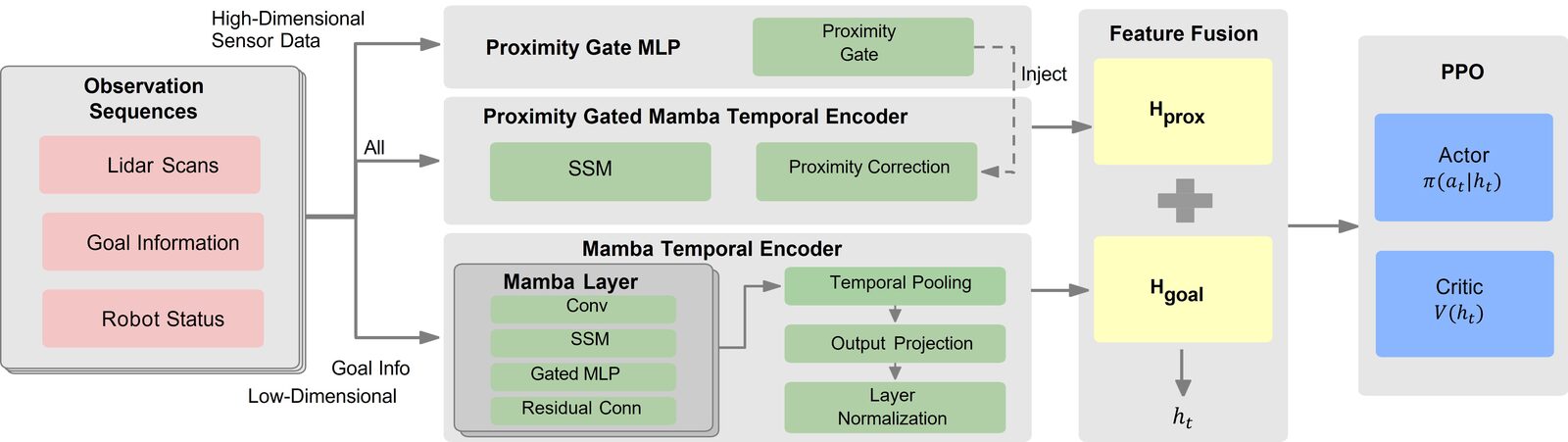
This paper proposes StratMamba, a dual-stream Mamba-based temporal modeling architecture that more efficiently captures the long-horizon temporal dependencies required for robot navigation in complex and obstacle-rich environments. StratMamba combines fast-decay and slow-decay memory streams: the fast-decay (proximity) stream processes high-frequency LiDAR data for reactive obstacle avoidance, while the slow-decay (goal) stream maintains longer-horizon goal information for strategic planning. We evaluate diverse obstacle-avoidance scenarios in IsaacLab and Gazebo, and validate successful sim-to-real deployment on a Unitree GO1 quadruped navigating around static and dynamic obstacles. Against temporal RL baselines (LSTM, Transformer, and Vanilla-Mamba), StratMamba achieves exceptional temporal-reasoning efficiency with a lower timeout rate while maintaining the fastest navigation speed (576 median steps, 5.0% better than Vanilla-Mamba) and the highest path optimality (0.915 path efficiency). In the real world, StratMamba remains robust across extended LiDAR ranges, demonstrating that dual-stream partitioning effectively balances reactive safety with strategic navigation under challenging sensing conditions.
Key Contributions
- Dual-rate state partitioning. A Mamba-based RL policy that separates reactive obstacle avoidance from strategic, goal-directed planning via complementary streams with disjoint input routing.
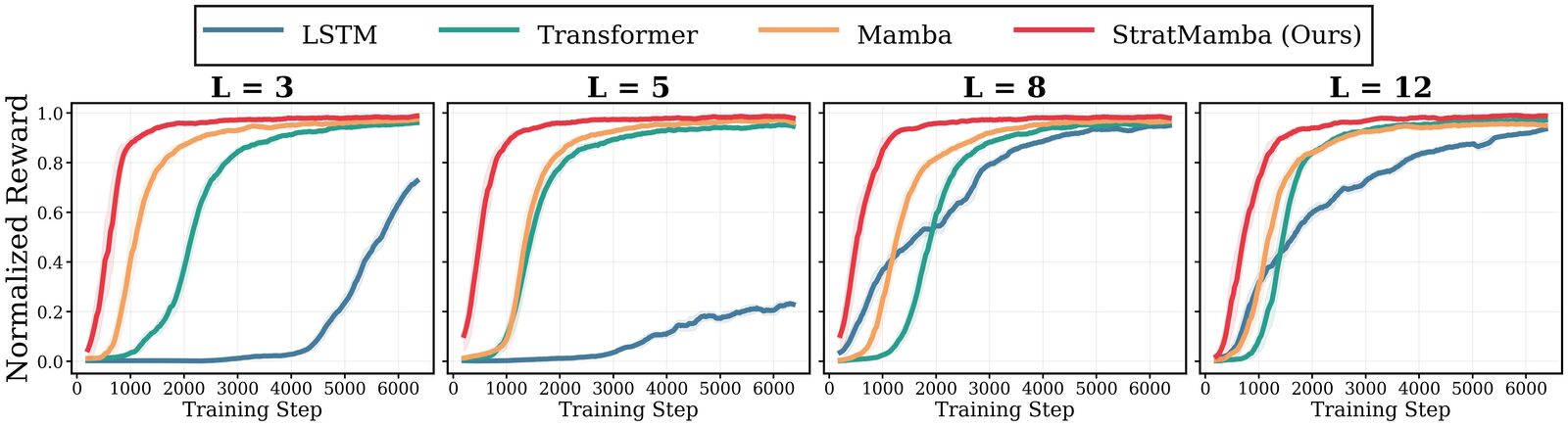
- Faster, more stable training. Converges up to 1.5× faster than LSTM and Transformer across all sequence lengths, while retaining Mamba’s linear O(L) complexity.
- State-of-the-art navigation. Lowest timeout rate (0.4% vs. 34.0% for LSTM), up to 13.4% higher path efficiency, and the smoothest trajectories (best SPARC and LDLJ).
- Robust sim-to-real transfer. Generalizes from IsaacLab (Unitree GO2) to Gazebo (Clearpath Husky) to a real Unitree GO1 — and stays reliable at extended LiDAR ranges where Vanilla-Mamba and Transformer fail catastrophically.
Results at a Glance
| Method | Timeout ↓ | Median steps ↓ | Path efficiency ↑ | SPARC ↑ |
|---|---|---|---|---|
| LSTM | 34.0% | 684 | 0.807 | −3.624 |
| Transformer | 1.1% | 621 | 0.851 | −3.594 |
| Vanilla-Mamba | 0.8% | 606 | 0.865 | −3.578 |
| StratMamba (ours) | 0.4% | 576 | 0.915 | −3.550 |
Averaged over sequence lengths L ∈ {3, 5, 8, 12} in IsaacLab. In real-world GO1 trials, StratMamba reaches the best success rate and SPL across both 1.5 m and 3.0 m LiDAR ranges.
Citation
Accepted at IROS 2026 — the paper is not yet publicly available. Full citation details (pages, DOI) will be updated upon publication.
@inproceedings{wu2026stratmamba,
  title     = {StratMamba: Strategic and Reactive Stream Partitioning for Path-Efficient LiDAR-Based Obstacle Avoidance},
  author    = {Wu, Hung-Chieh and Zhang, Xiaopan and Sinaei, Kasra and Abnavi, Ryan and
               Weerakoon, Kasun and Bradley, Christopher and Fakoorian, Seyed and Li, Jiachen and Ebeigbe, Donald},
  booktitle = {IEEE/RSJ International Conference on Intelligent Robots and Systems (IROS)},
  year      = {2026},
  note      = {Accepted, to appear}
}